
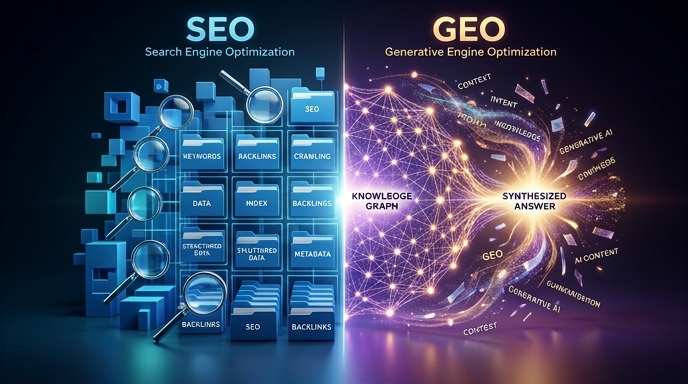
Search is changing. Generative Engine Optimization (GEO) determines whether AI tools like ChatGPT, Perplexity, and Google AI Overviews cite your content when answering user questions.
Generative Engine Optimization (GEO) is the practice of making content citable inside AI-generated answers instead of just ranked on a results page, and it's reshaping search in 2026 for any site that depends on organic visibility. SEO was the playbook: rank on Google, get clicks, get traffic. That playbook still works, but a growing share of search queries never reach a results page; they get answered directly by AI, using sources chosen by different rules than Google's ranking algorithm.
GEO is the discipline behind that shift, and it's changing how online visibility works.
What Is GEO?
Generative Engine Optimization is the practice of making your content discoverable, understandable, and citable by AI-powered answer engines.
SEO optimizes for a ranking algorithm. GEO optimizes for a comprehension and citation model. The goal isn't a position-one result - it's being the source an AI references when it explains something to a user.
AI tools that GEO targets:
- ChatGPT (with Browse and plugins)
- Perplexity AI
- Google AI Overviews (formerly SGE)
- Microsoft Copilot (Bing-powered)
- Claude (with web access)
- You.com, Kagi, and other AI-first search engines
When a user asks one of these tools "What is the best tool for X?" or "How do I do Y?", the AI synthesizes an answer from sources it can find, read, and trust. GEO is how you become one of those sources.
Researchers studying this shift describe today's AI tools in plain terms:
"can generate accurate and personalized responses, rapidly replacing traditional search engines like Google and Bing" — GEO research
GEO vs SEO: The Key Differences
Both disciplines share a foundation - quality content, fast websites, clean structure. But the optimization targets diverge.
| Dimension | SEO | GEO |
|---|---|---|
| Goal | Rank in search results | Be cited in AI answers |
| Audience | Google's ranking algorithm | LLMs and AI retrieval systems |
| Key signals | Backlinks, keywords, Core Web Vitals | Structured data, llms.txt, factual clarity |
| Measurement | Ranking position, organic traffic | Citation frequency, AI visibility audits |
| Content format | Long-form, keyword-optimized | Clear, factual, machine-readable |
SEO and GEO aren't competing - they're complementary. A site with strong SEO fundamentals has a head start in GEO. But GEO adds a layer of work that SEO alone doesn't cover.
Why GEO Matters Now
AI is changing the top of the funnel
When someone asks an AI assistant a question, they often get a complete answer without clicking anywhere. This is zero-click search, and it's accelerating: AI Overviews now appear on a large and growing share of Google queries, absorbing clicks that used to go to organic results. According to that same GEO research, "GEO can boost visibility by up to 40% in generative engine responses." Sites that adapt their content for AI citation are the ones capturing that lift.
The sites that get cited inside those AI answers still win. They build brand awareness, authority, and trust. The ones that don't get cited become invisible to users who default to AI tools over traditional search.
LLMs need a map
Large language models can't read everything. They rely on crawlability signals, structured metadata, and formats like llms.txt - a plain-text file that tells AI crawlers what your site covers, what content exists, and how to use it. Without clear structure, AI tools guess - and they often skip you entirely.
Trust signals differ from link signals
Google counts backlinks as votes of authority. AI systems look for factual consistency, structured data (JSON-LD schema), clear entity definitions, and authoritative sourcing. A page with ten backlinks and solid schema often outperforms a page with a hundred backlinks and no markup in AI citation results.
How to Optimize for Generative Engines
1. Publish an llms.txt file
An llms.txt file at yourdomain.com/llms.txt is a machine-readable index of your site's content - written for AI crawlers. It lists your key pages, their purpose, and optionally full-text content. Think of it as a sitemap built for AI.
2. Add structured data (JSON-LD schema)
Schema types like Article, FAQPage, HowTo, Organization, and Product help AI systems understand what your content is, not just what it says. A blog post marked up as Article with author, publish date, and headline gives AI tools the metadata they need to cite it with confidence. The shared vocabulary behind these types lives at schema.org, maintained jointly by the major search engines.
3. Write for clarity, not density
AI systems can read prose far better than keyword-match algorithms - but they still struggle with vague, padded writing. The clearest answer wins. Write specific, factual sentences. Define your terms. Use headers that state the point.
4. Monitor your AI visibility
SEO has rank trackers. GEO needs AI visibility audits - regular checks on which pages AI tools can see, llms.txt coverage, and how often your content gets cited. Without measurement, you can't improve.
5. Keep content fresh and crawlable
AI tools re-index constantly. Stale content, blocked crawlers, or slow pages drop out of the citation pool. Fresh, fast, accessible content stays in it.
How geodeck Helps
geodeck automates the infrastructure work that AI visibility depends on:
- Generates and maintains your
llms.txtautomatically as you publish - Audits your schema markup and flags missing or malformed structured data
- Submits URLs to IndexNow and Google Search Console so crawlers find new content fast
- Monitors AI visibility signals across your domains
- Mirrors content to Markdown to maximize machine readability
IndexNow submission matters because it's verifiable in real time. Per the IndexNow documentation: "A successful request will return an HTTP 200 response code" - instant confirmation that an update reached search engines instead of waiting on the next crawl.
Whether you run a blog, a SaaS product, or an e-commerce site, geodeck keeps your AI search optimization running without manual work.
The Bottom Line
SEO got you ranked. GEO gets you cited. In a world where AI answers are replacing results pages for millions of queries every day, being cited is the new being ranked.
Start with your llms.txt. Add schema. Write clearly. Measure. The sites that invest in GEO now build a compounding advantage as AI search keeps growing.